Exoplanet searching around evolved stars
 By Huanyu Teng
Background
To date, more than 5000 extra-solar planets (exoplanets) have been detected around different types of stars. These exoplanets were detected by different methods, among which the radial velocity (RV) method (Doppler method) contributed to around 800 of them. For these planets, about 60% are detected around solar-mass (0.7–1.5 M⊙) stars, while only about 1% are detected around intermediate-mass (1.5–5.0 M⊙).
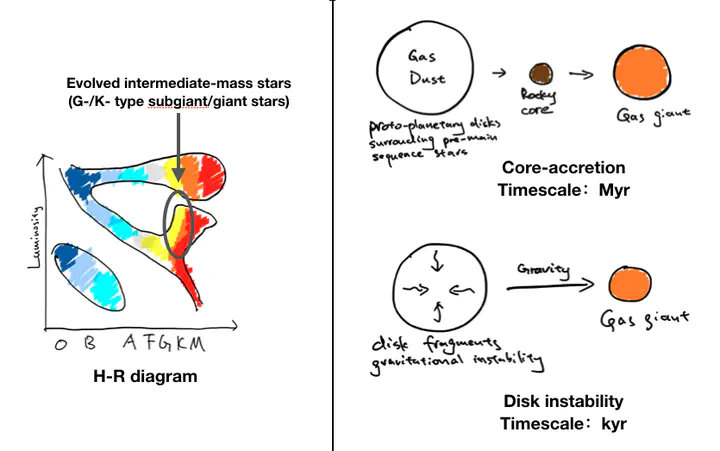
Intermediate-mass stars are B- or A- or F-type stars at main sequence, and G- or K- type at more evolved stages (subgiants and giants). Compared to their main-sequence counterparts, these stars are better for planet searching with RV method because they rotate slowly and have sharp absorption lines.
Since the intermediate-mass stars have shorter lifetime than less-massive stars, they are valuable objects to constrain the mechanism and timescale of planet formation.
There are two popular planet formation scenarios for gaseous giant planets. One is core accretion, which has a timescale of about a few million years. In this model, a rocky core forms through the coagulation of planetesimals until it is sufficiently massive (about 10 M⊕) to accrete a gaseous envelope. Another one is disk instability, which has a timescale of about only a few thousand years. In this model, gas giant planet forms directly as a result of (local) gravitational instability in the protoplanetary disk.
To characterize how the giant planets are and to recover how they form, it is urgent to survey intermediate-mass stars at their evolved stages.
Issues in my research
Thanks to large surveys during the last 20 years, more interesting issues are realized about giant planet populations. Here I present some of them which are within my interest:
“Planet desert”
Close-in (a < 0.6 au), low-mass (Mp < 0.6MJ ) planets were seldom found around intermediate-mass planets. Especially for more evolved giant stars, most detected planets reside at more than 0.5 au from their hosts.
The desert could be attributed to a scaling of the proto-planetary disk mass with the mass of the central star, and it could also be a result of planet engulfment while a star is ascending the red giant branch.
Related publication:
“A Close-in Planet Orbiting Giant Star HD 167768”The giant-planet metallicity correlation
Among all detected giant exoplanets, they are more likely to reside around metal-rich stars. For the evolved stars, the existence of giant-planet–metallicity correlation is a more popular. But some give no clear correlation. It is somewhat under-debating…
Related publication:
“Revisiting Planetary Systems in Okayama Planet Search Program: A new long-period planet, RV astrometry joint analysis, and multiplicity-metallicity trend around evolved stars.” “Regular radial velocity variations in nine G- and K-type giant stars: Eight planets and one planet candidate”Multiplicity of giant planets
To date, there are around 30 multi-planet systems discovered around deeply evolved stars (logg<3.5). Most of them are in the pattern of massive planet pairs and having intermediate periods (100 ~ 1000 days), and many of pairs are considered to be in mean motion resonance. Why are they mostly in pairs? What have they experienced?
Related publication:
“A Trio of Giant Planets Orbiting Evolved Star HD 184010”Data in my research
Observations
I use precise radial velocity data within the framework of Okayama Planet Search Program and its extended programs.
Statistics
Data are obtained from NASA Exoplanet Archive and Exoplanet.eu.

Huanyu Teng 滕环宇
PhD of Earth and Planetary Sciences
I am now working on (1) measuring stellar obliquity of young planetary systems (2) planet searching around evolved stars and Late M dwarfs with radial velocity method.